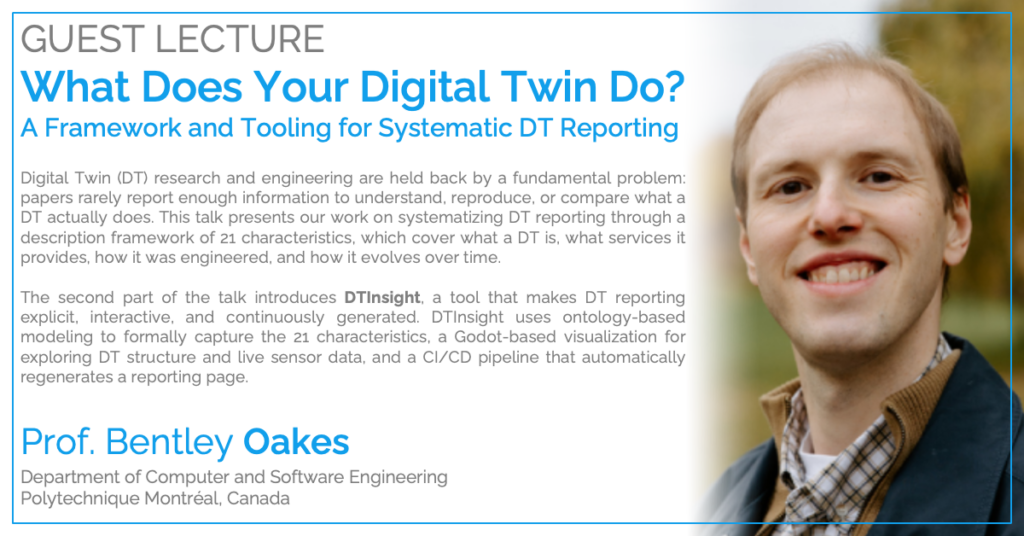
It is my pleasure to welcome my good friend, Professor Bentley Oakes (Polytechnique Montréal) as a guest lecturer in my Engineering Digital Twins course at McMaster University (CAS 782) this coming Tuesday.
In his talk What Does Your Digital Twin Do? A Framework and Tooling for Systematic DT Reporting, Professor Oakes will present a principled approach for reporting and conceptualization of digital twins through a framework he built over the past years. Recently, Professor Oakes has been developing tool support to make use of these structured reports; a topic he will touch upon, too.
Tune in if you are interested!
𝗪𝗵𝗲𝗻: March 17 at 1PM-2:30PM ET.
𝗪𝗵𝗲𝗿𝗲: https://lnkd.in/eP9DU_4y
𝗕𝗶𝗼: Prof. Oakes is an Assistant Professor in the Department of Computer and Software Engineering at Polytechnique Montréal, Canada. He completed his Master’s and PhD at McGill University, before becoming a post-doctoral researcher at both the University of Antwerp and the Université de Montréal. His interests and experiences are diverse, ranging from digital twins (including their structure, construction, and reporting) to model-driven engineering, ontologies, verification and validation, machine learning, and many other topics. His current research focuses on tools and methods that help domain experts model, construct, and reason about complex systems, with a particular focus on Digital Twin engineering.
𝗔𝗯𝘀𝘁𝗿𝗮𝗰𝘁: Digital Twin (DT) research and engineering are held back by a fundamental problem: papers rarely report enough information to understand, reproduce, or compare what a DT actually does. This talk presents our work on systematizing DT reporting through a description framework of 21 characteristics, which cover what a DT is, what services it provides, how it was engineered, and how it evolves over time. To ground the framework, we show how it describes DTs in cooperative robotics and marine research.
The second part of the talk introduces DTInsight, a tool that makes DT reporting explicit, interactive, and continuously generated. DTInsight uses ontology-based modeling to formally capture the 21 characteristics, a Godot-based visualization for exploring DT structure and live sensor data, and a CI/CD pipeline that automatically regenerates a reporting page. We close with ongoing work on reducing the manual effort of ontology modeling.